
by Dr. Ashley Vance
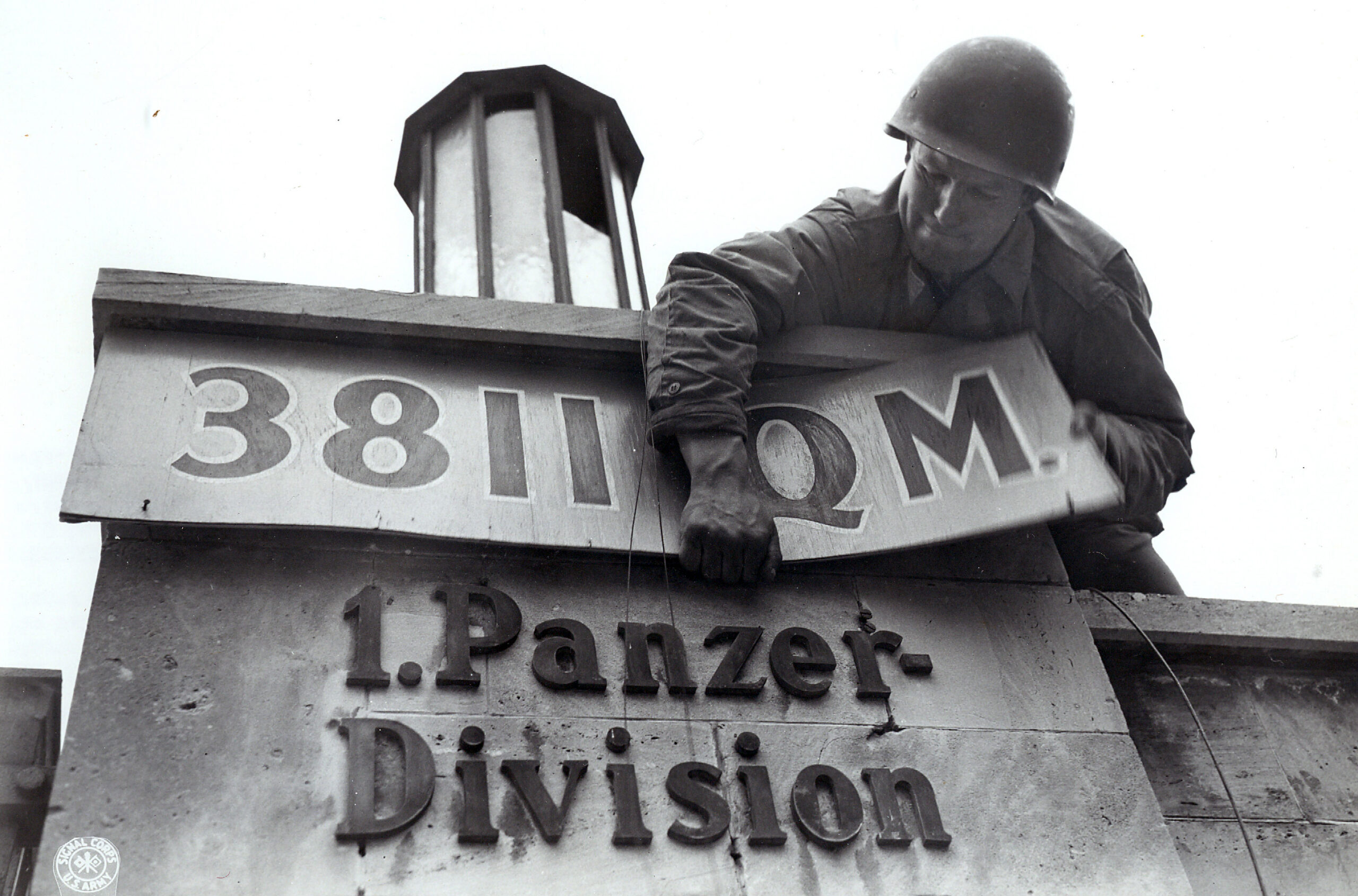
Pfc. Jesse F. Heath removes the 3811th Truck Company sign from a building in Weimar, Germany, before the territory was turned over to the Soviet Red Army. The building had formerly housed the Nazi 1st Panzer Division. Army Signal Corps photo; George C. Marshall Foundation.
How did the U.S. Army go from occupying defeated Germany to standing guard against a possible Soviet invasion? In this article from the 2023 Winter issue of MARSHALL magazine, Dr. Ashley Vance traces the postwar transformation of U.S. forces in Germany into the Cold War Army. For a deeper discussion, listen for Dr. Vance’s interview in the first season of Age of Marshall, the George C. Marshall Foundation’s upcoming podcast exploring Marshall, his era, and the world he helped shape.
By the time Seventh Army reactivated for the Korean War in 1950, an army built for the Cold War was already in place in occupied Germany.
In 1954, The Big Picture, the Army’s weekly television show, explained to potential draftees that “we are trying to mobilize in peacetime for any eventuality.” A year after the Korean War ended, the Army still needed soldiers. Throughout the 1950s, U.S. Army, Europe (USAREUR), firmly entrenched in the center of Cold War political tensions, maintained a force of more than 230,000 soldiers to deter a Soviet invasion into West Germany. Preparing for a war that would ultimately never come, the Army presence in Europe was predicated on its ability to maintain combat readiness in case of an emergency. Commonly known as the “Cold War Army,” this ground force spent most of its time preparing for that mission.
However, the Army presence in postwar Germany was not always a large deterrent force. Following World War II, the Army managed an unprecedented military occupation while it conducted the largest demobilization program it had ever undertaken. Demobilization devastated the units that stayed behind in occupied Germany. In the first two years of the occupation, the number of troops shrank from nearly three million to a mere 90,000 soldiers. Shrinking numbers also meant a loss in combat readiness. Simply put, the Army in Europe was no longer a capable fighting force. Yet, by mid-1951, a quarter of a million U.S. soldiers in West Germany spent much of their time conducting training exercises and field maneuvers.
So how did the Army transform from an ineffective occupation force to a large, combat ready Cold War Army? The core of this change took place in 1947 when European Command (EUCOM) reorganized occupation forces for combat. More than a year before the Berlin Airlift, the Army began to build a force for the Cold War when it accepted its role as the military arm of the developing political contest between East and West. By the time Seventh Army reactivated for the Korean War in 1950, an army built for the Cold War was already in place in occupied Germany. The arrival of 180,000 troops in 1951 cemented the transformation of the World War II Army into a Cold War Army.
Demobilization and the Police Type Occupation
At the end of World War II, the Army’s top priority was the demobilization of almost three million soldiers. At the same time, it began the military occupation of defeated Germany. Military Governor General Lucius Clay remarked that “Nobody had had any experience in this kind of job…In Germany we had no background, because after World War I, there was always a German government; occupying troops were there for military purposes…We had nothing. We had to improvise, we had to make decisions on the spot.” Indeed, improvisation to meet new needs would come to define the occupation.
The first major initiative to combat the personnel issues caused by demobilization transformed the very nature of the occupation. The Army’s original occupation concept was to have what Earl Ziemke called an “Army Type Occupation” with a large soldier presence and a strategic reserve. Given the manpower problems, Army Chief of Staff General George C. Marshall suggested to General Dwight Eisenhower the use of a “Police Type Occupation” based on the premise used in Japan. Eisenhower agreed but rejected the part of the model that employed local police. Instead, an Army police force would provide all security and order throughout the Occupation Zone. The new U.S. Zone Constabulary police occupation would be led by a Corps-sized mobile unit that would be supported by a smaller, tactical reserve. Stars & Stripes noted that the “bold experiment” represented “a departure into a new military field of operations for the Army” and was “about the only alternative, for a larger army has been a continuous headache of dubious morale, slack discipline, and untrained men.”
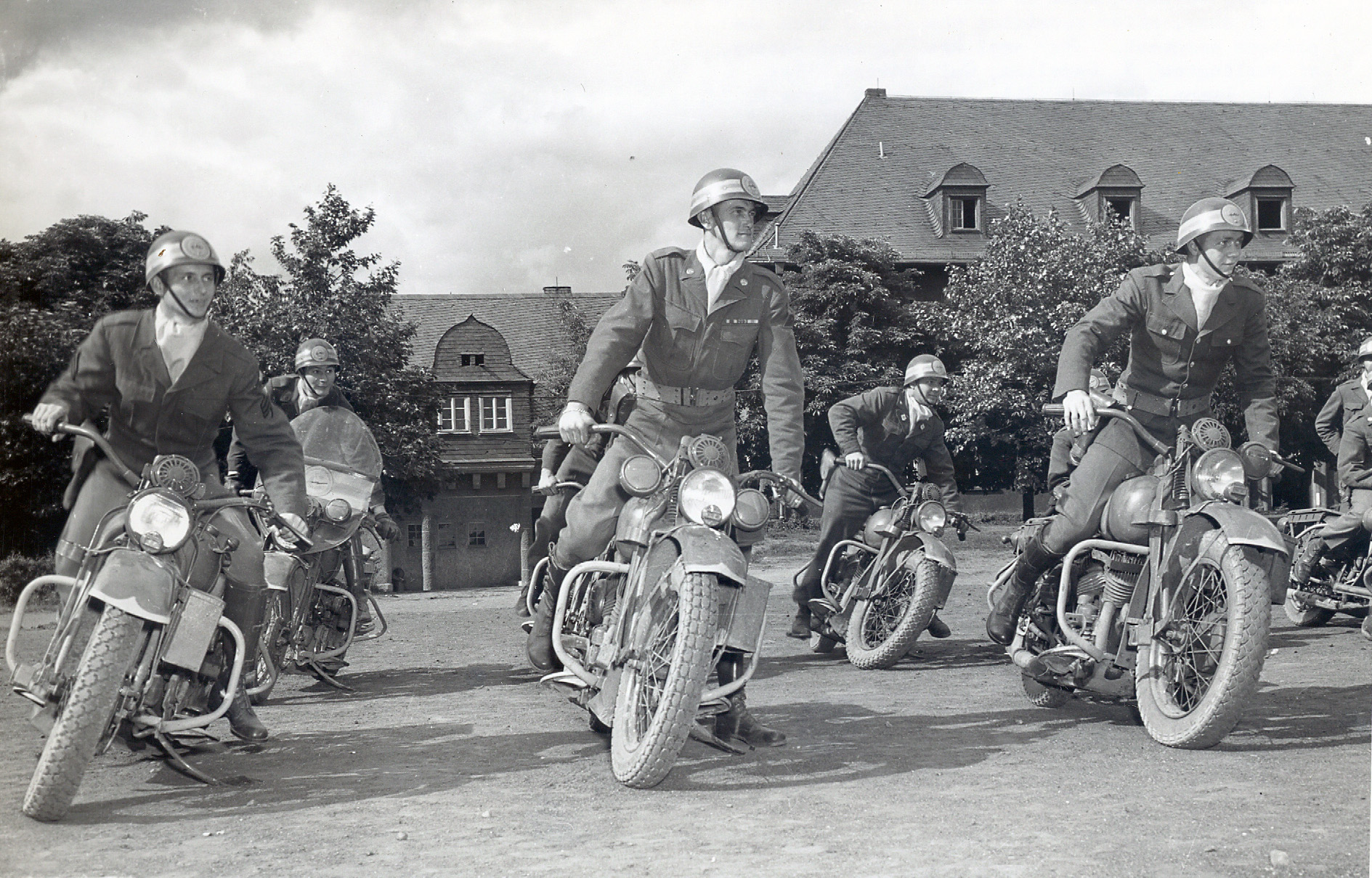
Members of the 3rd Constabulary Regiment stationed in Wetzler, Germany. Pictured are Sgt. Raymond Massey, Cpl. Edward Miles, and Tec 5 Lewis E. Briggs. June 4, 1964. Army Signal Corps photo; George C. Marshall Foundation.
Want more stories from the Marshall Foundation?
Get new articles, guides, event announcements, and streams in MARSHALL MOMENTS, the monthly e-newsletter from the George C. Marshall Foundation.

Although the plan was for the Constabulary to have a tactical reserve, that plan did not come to fruition. By the time the unit became fully operational in mid-1946, it was only supported by the 1st Infantry Division, the remaining combat unit in occupied Germany. Scattered throughout the U.S. Zone, the two units maintained security, both within the Zone and along its 1,400 miles of semi-international and internal boundaries. The biggest consequence of transforming the occupation from an “Army Type” to a “Police Type” occupation was the collapse in combat readiness.
Even though the Zone itself was secure, units in Germany were no longer capable of defending themselves or their Allied neighbors from an external attack. While not an immediate threat, the rising tensions with the Soviet Union made the issue an ever-present concern. To cope with this problem, Army commanders in Germany improvised and experimented new policies into existence. First among them was the process to involve the German police in zonal security. The Constabulary partnered with German police forces, allowing them to slowly take on duties, such as border patrols, being conducted by the Army police. This gave the Army the flexibility to accomplish close to the same security goals with a fraction of the manpower. This smaller force met the War Department, President Truman, and the American public’s demands for a smaller military in the postwar period. In essence, the Constabulary gave the Army the flexibility it needed to grapple with larger security problems.
The year-long reorganization to rebuild combat readiness marked the fundamental punisher-to-protector shift in the occupation.
By the end of 1946 it was clear that a Nazi resurgence was not going to materialize. But the external Soviet threat was growing, and planners needed to respond. A report at the time noted that “the realization served to justify, in the minds of planners, a more equitable distribution of manpower between Occupational duties and a combat reserve.” This new approach was both a proactive effort to be prepared for a Soviet invasion and a reaction to the disintegration of unit effectiveness.
Rebuilding Combat Readiness in 1947
The Army of World War II no longer existed. At the beginning of 1947 there had been almost no tactical training in Germany for more than eight months. Therefore, a major initiative would have to take place to reorient the occupation for combat. After months of planning, a Theater-wide reorganization got underway in February 1947. The Constabulary and 1st Infantry Division units were reorganized to have a combat focus, instead of a focus on policing and border security. Interestingly, planners began the overhaul without requesting more troops while demobilization, poorly trained incoming recruits, and high turnover continued.
The year-long reorganization to rebuild combat readiness marked the fundamental punisher-to-protector shift in the occupation. Too often, scholars put this transition at the beginning of the Berlin Airlift in 1948 or at the formation of the Federal Republic of Germany in 1949. However, the new combat focus had been underway for more than a year before the Berlin crisis began. The reorganizations that took shape in spring 1947 were specifically aimed to rebuild a combat reserve for the defense of Germany. For the Army in Germany, the “punisher” phase saw the decimation of troop levels, combat readiness, and a principal switch to a newly conceptualized “Police Type Occupation.” The “protector” phase began with an understrength, unprepared occupation force that consisted of just one scattered division and a mobile Corps-sized police force. USFET needed forces in Germany to return to their former capabilities, but it had to rebuild on a shoestring budget. Therefore, steps were taken at all levels of command from Washington to Heidelberg to solve the occupation’s problems and face the developing Cold War.
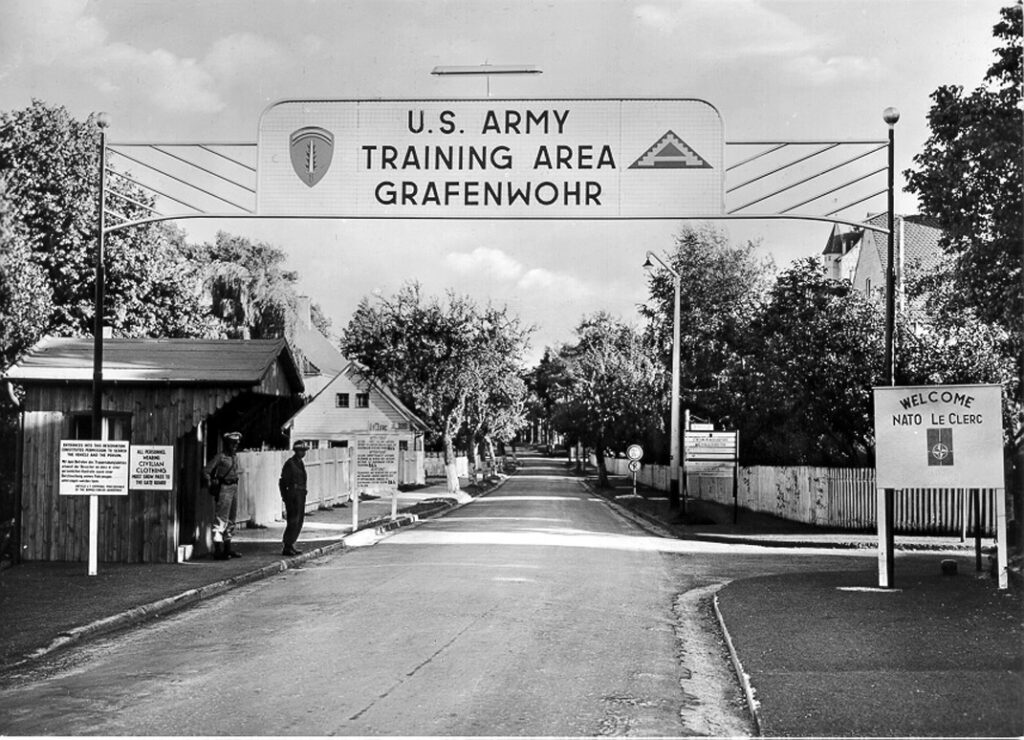
Historical photo of Grafenwöhr Training Area. Source: home.army.mil/bavaria/index.php/history
The opening of the training camp at Grafenwöhr in spring 1947 marked the beginning of European Command’s public commitment to establish a combat reserve and initiated the formation of what would become the Cold War Army in Germany. Before 1947 training focused on border security, lightning raids, and individual readiness to compensate for poor soldier quality in the replacement system. After 1947, training was for combat. General Huebner and commanders at EUCOM, with a preference to use infantry units for defense, predicted that the “Constabulary unit would be deactivated over the next three years as the German government assumed responsibility for internal security.” If the transition was completed as planned, the Constabulary would no longer be a full-time job. Many considered this slow elimination of the Constabulary a reflection of the unit working itself out of a job. If fully successful, German police would be capable of handling all zonal security. The benefit of the handoff was the freeing up of soldiers to train at Grafenwöhr as an alternative to requesting more soldiers.
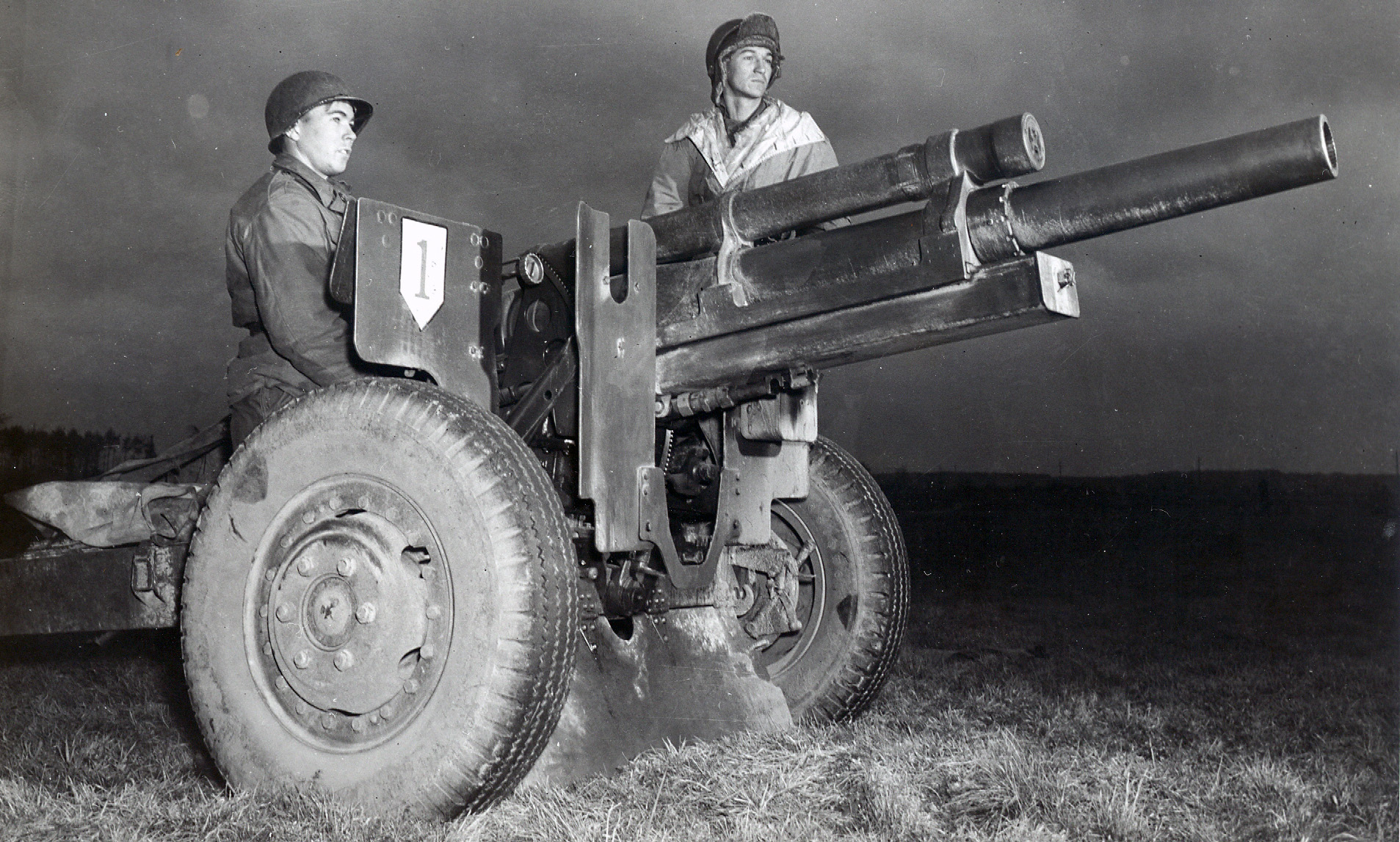
Pfc. Cecil Counts (left) and Pvt. James W. Pitts (right), both members of a 105mm howitzer crew of “B” Battery, 7th Field Artillery Battalion, await firing orders during Operation Snowdrop, January 20, 1949. Army Signal Corps photo; George C. Marshall Foundation.
Training the Cold War Army
The defining feature of the Cold War Army was the training it conducted for its defensive mission. Unlike their counterparts in occupied Japan, the soldiers of the postwar German occupation spent most of their time training for combat. The peacetime mission afforded the men the ability to do so. It was generally understood, and proven by the Korean War, that the next conflict would come without prior notice. Troops in Europe, therefore, needed to maintain a state of readiness not previously held by American peacetime forces. Also unlike other deployments, the maneuvers were highly visible and closely connected to the local population. Exercises in Germany took place off base and were intermixed throughout cities and villages. Training centers and schools were often set up adjacent to towns for the close access to infrastructure and field maneuvers traversed farmlands and villages. In an area as small as the U.S. Zone of Occupation in Germany, it was virtually impossible to separate the thousands of American soldiers from the sprawling German population.
The troop augmentation to Germany that followed the beginning of the Korean War was nothing short of miraculous.
After spending two years transforming units to have a combat focus, EUCOM officially recognized the defensive mission in Germany in 1950. This recognition was a culmination of the increased Cold War tensions, the growing Soviet military threat, and the Korean War. But the small occupation force was not capable of actually defending West Germany. General Matthew Ridgway once remarked that, “The greatest weakness in this potentially powerful force [in Europe] lies in the vast front that it must cover, and in the disparity of the number of men under arms as compared with the strength of the Russian forces…The first thing we had to do…was to set up the vast and complex logistical structure which would support the forces we had if they should be committed to battle.” That logistical structure included getting more forces to Germany and building the infrastructure to house and train them.
The troop augmentation to Germany that followed the beginning of the Korean War was nothing short of miraculous. The number of troops in West Germany in summer 1950 was approximately 80,000. Less than a year later, that number ballooned to more than 250,000 soldiers. At the beginning of 1952, General Handy reflected on the troop mobilization thus far and remarked that, “Everything has not gone absolutely smoothly but the surprising thing is that we have been able to do it as well as we have. We have gotten them housed and we have gotten training facilities, etc…I do not think we realize sometimes what a big job some of our people have accomplished.” The troop expansion was a massive undertaking for the Cold War Army. EUCOM and USAREUR faced an unprecedented challenge to expand a peacetime occupation mission in a semi-sovereign nation – and commanders learned how to do so in real time. Developments in the occupation, including preparing for and accepting the soldiers, expanding the infrastructure to support them, conducting racial integration, and adjusting to the rise of dependents, all happened within the context of that real-time growth. In many cases, leaders improvised as they learned how to expand, adjusting plans and policies to meet the demands and challenges that arose in the process.
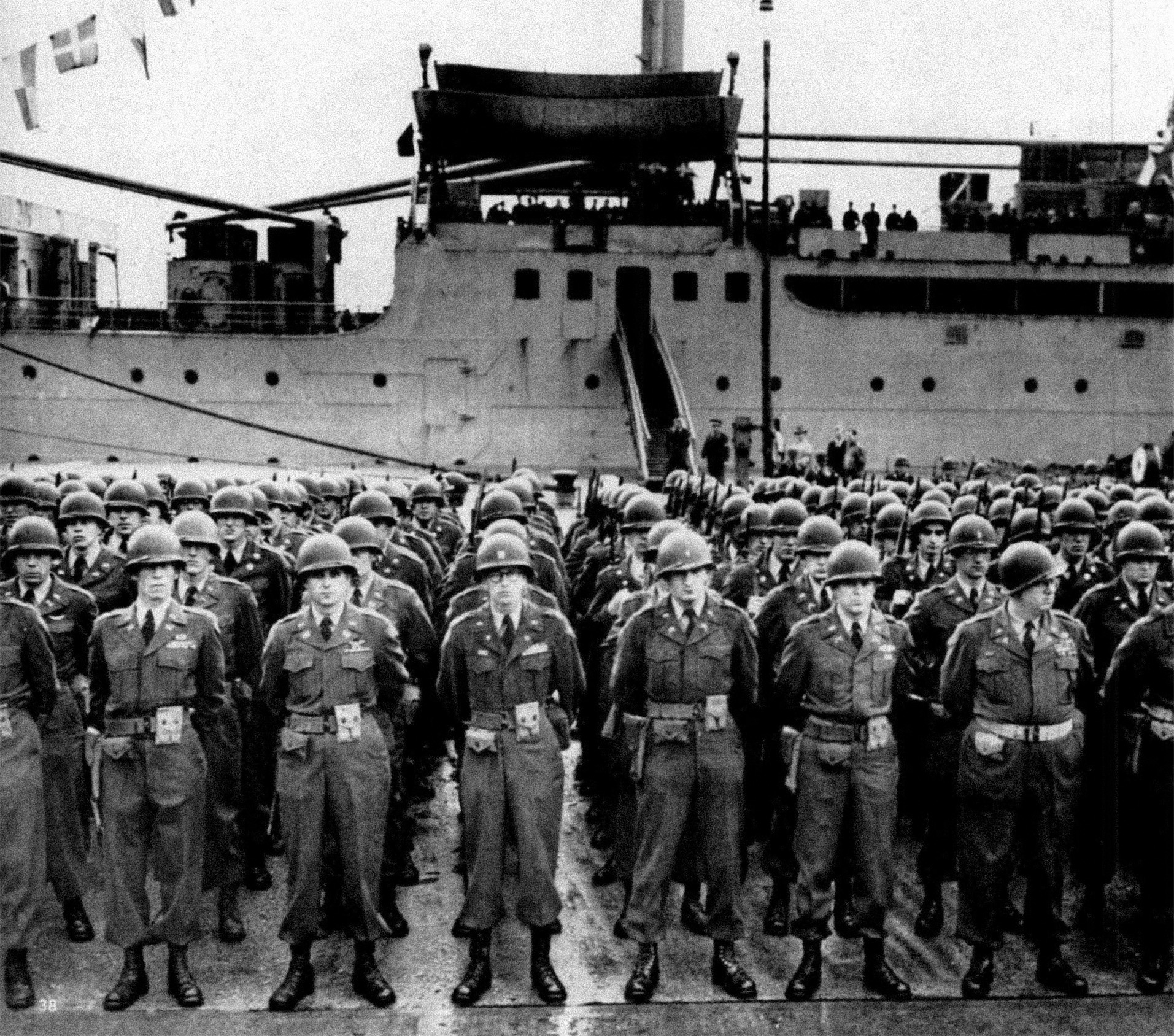
4th Infantry Division disembark at Bramerhaven, Germany, May 27, 1951. AP photo; supplied by Dr. Vance.
From Temporary Deployment to Permanent Presence
The infrastructure built for the incoming troops, including the rehabilitation of existing kasernes and the construction of new housing, was completed with an expectation that American forces would one day leave and turn the properties over to the West Germans. Even after the commitment to increase the forces in Europe was made in fall 1950, the presence of American forces continued to be viewed as a temporary venture. Bruno Thoß noted that leaders thought the troop augmentation would “only be a temporary measure until European rearmament had reached the point that the Europeans were capable of regional self-defense.” Indeed, even the negotiations for the addition of troops to Europe were provisional because of the new semi-sovereign status of the Federal Republic. The assumption, on all sides, was that U.S. forces would leave after the occupation ended and the West German government was allowed to rearm. However, in the process of expanding to accept an additional four divisions, the Cold War Army created a sense of permanence in West Germany.
It was an army devoted to discouraging a fight, but meanwhile, building up a solid punch should it come.
The arrival of troops was just the first step in a broader initiative to secure Western Europe; a mission that ultimately continued for another forty years. As General Eisenhower reported to NATO in April 1952, “There is no real security yet achieved in Europe; there is only a beginning.” Politically, the question of German rearmament needed to be answered. The conclusion of the Bonn Convention negotiations in early 1952 theoretically dealt with that issue, although it would not be solved until 1954. Militarily, U.S. forces needed to prepare for the worst-case scenario. The expansion of field maneuvers in the early 1950s allowed EUCOM and its NATO allies to work through invasion scenarios and, later, to test the effectiveness of using atomic weapons in a war against the Soviets.
The American occupation of Germany ended on May 5, 1955. The event was widely publicized and heralded as a political victory. The New York Times celebrated the success when it said the United States “fashioned the new state out of the debris of the Nazi military collapse in 1945 and then acted as godfather, endowing the infant with worldly goods and guiding its first footsteps in the new world.” However, for all of the publicity, very little changed on the ground. Stars & Stripes explained that “For the man in the street, there will be little immediate impact from the changed status.” This was in part because the “occupation had been so benign in the last two years that its official ending went virtually unnoticed.” The permanence created when 200,000 soldiers arrived in the early 1950s set the tone for the military presence in Germany for the foreseeable future.
The Big Picture summed up the purpose of Seventh Army in Germany as “army on alert, ready to meet trouble out of the east.” It was “an army devoted to discouraging a fight, but meanwhile, building up a solid punch should it come.” The Cold War Army stood ready to face the Soviet if it invaded. It focused its efforts in preparing for that possibility. The transformation of the World War II Army into a Cold War Army provided the foundation for the force that remained in West Germany until the end of the Cold War, that ultimately, remains there today.
About Dr. Ashley Vance
Dr. Ashley Vance is a military historian specializing in the U.S. Army in post-World War II Germany and the early Cold War. She received her doctorate from Texas A&M University and has held positions with the U.S. Army Center of Military History and the U.S. Naval History and Heritage Command. A longtime contributor to the George C. Marshall Foundation, Dr. Vance has also supported the Foundation’s digitization work as a subject expert and metadata technician, helping make the Marshall Papers more discoverable for researchers.
Additional Resources
WATCH: “An Army on Alert” Legacy Lecture by Dr. Ashley Vance
READ: A Modern Haus for Marshall by Cody Youngblood