
George Washington, George Marshall, and the American Military Tradition
Originally delivered as USAFA Harmon Memorial Lecture #26, Don Higginbotham’s “George Washington and George Marshall: Some Reflections on the American Military Tradition” places two American soldiers-statesmen in conversation. Washington belonged to the founding generation; Marshall helped shape the twentieth century. Higginbotham argues that their shared habits of restraint, duty, candor, and civilian-minded command illuminate something durable in the American military tradition.
A Relevant Past for Military Affairs
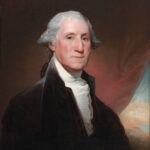
The title of this lecture suggests the obvious: that I consider it informative and instructive to look at certain similarities of experience and attitude shared by George Washington and George Marshall. In so doing, I want to speculate on their place in the American military tradition. These introductory remarks sound as though I am searching for relevance, and that is the case. No doubt at times historians, to say nothing of their readers, wish that the contemporary world would get lost so as to leave them unfettered to delve into the past for its own sake. Actually, for the first time in history there is the possibility that the contemporary world will go away but not in a manner that will be a boon to historical scholarship or anything else. That fear alone is enough to keep us searching—even desperately at times-for a relevant past, and in no area more so than military affairs broadly defined.
Virginia, Retirement and Public Duty
Some of the similarities between Washington and Marshall are more relevant than others, but it might be useful to enumerate a number of them now and still others later when we endeavor to link the two men in terms of the American military tradition. Both are commonly thought of as Virginians, and Marshall has been referred to as the last of the Virginians. If in truth, Marshall was a Pennsylvanian by birth-he admitted that his nasal twang gave him away-here was much of Virginia in his life. His home, Uniontown in western Pennsylvania, was once part of Virginia’s vast claim to the Ohio Valley. Because of that claim Washington had fought in the immediate region of Marshall’s youth. As a schoolboy Marshall had hunted and fished at locations where Washington had vanquished a small French party under Sieur Coulon de Jumonville, where Washington later built Fort Necessity and bad then himself capitulated to the Gallic enemy, and where—following Braddock’s defeat—Washington and others had buried the ill-fated general.
“Dodona Manor at Leesburg…was to be his own Mount Vernon.”
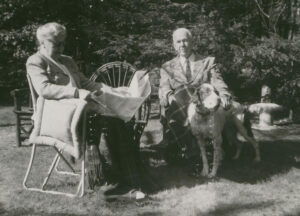
George and Katherine Marshall sit on the lawn of Dodona Manor in Leesburg, Virginia, with Bones, their grandson’s Llewellin Setter.
A distant relative of Chief Justice John Marshall, George Marshall had family roots in Virginia; he graduated from Virginia Military Institute; and he retired in 1945 to a Virginia country seat—having expressed a desire, as did Washington, to enjoy a simple, bucolic life after a long career of public service. Dodona Manor at Leesburg—an imposing old dwelling that had once belonged to Washington’s grandnephew—was to be his own Mount Vernon. There he would rest and reflect, to quote Washington metaphorically, under “my own vine and fig tree.” (Or as Marshall would have expressed it, with his beloved roses and tomato plants). Both genuinely wished to escape the limelight; having no desire to profit further from their past accomplishments, they rejected appeals from publishers and well-wishers to pen their memoirs. In Marshall’s case, the offer of a million dollars from the Saturday Evening Post came when he had $1,300 in the bank.
Neither general, however, was destined to see his dream of solitude and privacy gratified at war’s end. Ever selfless and responsible, they could not decline when duty again beckoned but in a different form: Washington became the nation’s first president, and Marshall headed a postwar mission to China before serving as secretary of state and secretary of defense in the Truman administration. Something about their personal character explained their willingness to come forth once more on behalf of their country, and it is in the realm of character that the Virginia connection between Washington and Marshall rests most firmly in the public mind. For Marshall, like Washington and the other great Virginians of his generation, was thought to be a rock of stability, completely dedicated and committed to the cause he espoused
Reserve, Candor, and Command
The fact that neither the native Virginian nor the adopted Virginian was a backslapper or gregarious but just the opposite—remote and aloof—added to the aura that surrounded each man. Though both were named George, that in itself is hardly noteworthy, for neither as an adult encouraged first-name familiarity and could be downright chilling to those who tried to breach their inner walls. If, as the saying goes, a picture is worth a thousand words, perhaps the point about eschewing familiarity is best made with anecdotes.
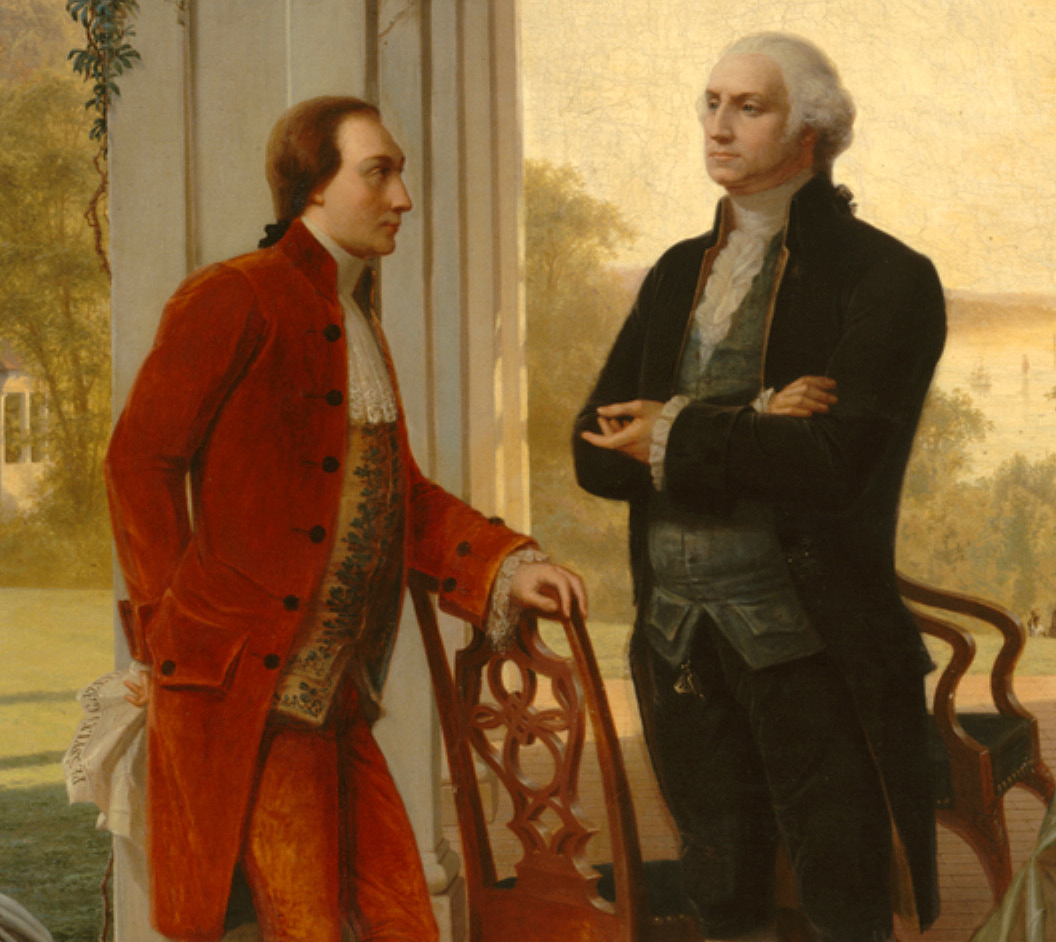
Detail of “Washington and Lafayette at Mount Vernon, 1784 (The Home of Washington after the War),” Louis Rémy Mignot and Thomas Prichard Rossiter, 1859. Metropolitan Museum of Art. Public domain.
While participating in the Constitutional Convention at Philadelphia in 1787, several delegates were commenting on Washington’s reserve and distant manner. The bold and witty Gouverneur Morris felt that his colleagues had exaggerated, saying that he was as intimate with Washington as he was with his closest friends. To which Alexander Hamilton responded by issuing Morris a challenge, offering to provide wine and supper at his own expense if Morris would approach Washington, slap him on the back, and say, “My dear General, how happy I am to see you look so well.” On the designated occasion, Morris carried out his part of the bargain, although evidently with a degree of diffidence that had scarcely been expected in view of his earlier expression of confidence. Morris stepped up to Washington, bowed, shook hands, and gingerly placed his left hand on Washington’s shoulder. “My dear General,” said Morris, “I am very happy to see you look so well.” Washington’s reaction was instantly frigid. Removing the hand, he stepped back and glared silently at the abashed Morris, as the assemblage watched in embarrassment.
“I wasn’t very enthusiastic over such a misrepresentation of our intimacy.”
The Washington anecdote, however revealing of the man’s normal posture, may be apocryphal, but our Marshall story is authentic. At his initial official conference with President Franklin D. Roosevelt in 1938, Marshall, freshly minted deputy chief of staff, was asked a leading question about air power with which he did not agree. Roosevelt, thinking he had made an effective case for a priority in planes, said, “Don’t you think so, George?” Marshall eyed the president icily and replied, “Mr. President, I am sorry, but I don’t agree with that at all.” Roosevelt, who first-named one and all, never after that addressed Marshall by anything but general. As Marshall himself recounted later, “I wasn’t very enthusiastic over such a misrepresentation of our intimacy.”
Teaching the American Soldier
While Washington was never an instructor in a formal sense, he urged the creation of a military academy, a step which was delayed until Jefferson’s Presidency. Marshall, who taught and occasionally lectured at a number of military institutions, has been particularly praised for his positive impact on the officer students and junior instructors at the Infantry School, where during his five years as deputy commandant he dealt with two hundred future World War II generals, including Bradley, Collins, Ridgway, Stilwell, and Van Fleet. As early as 1937, before it was clear that Marshall would vault the seniority obstacle and make it to the top rung of the military ladder, there were officers-so Marshall learned from Lt. Col. John F. Landis—”who regard[ed] themselves as self-appointed ‘Marshall men’.”
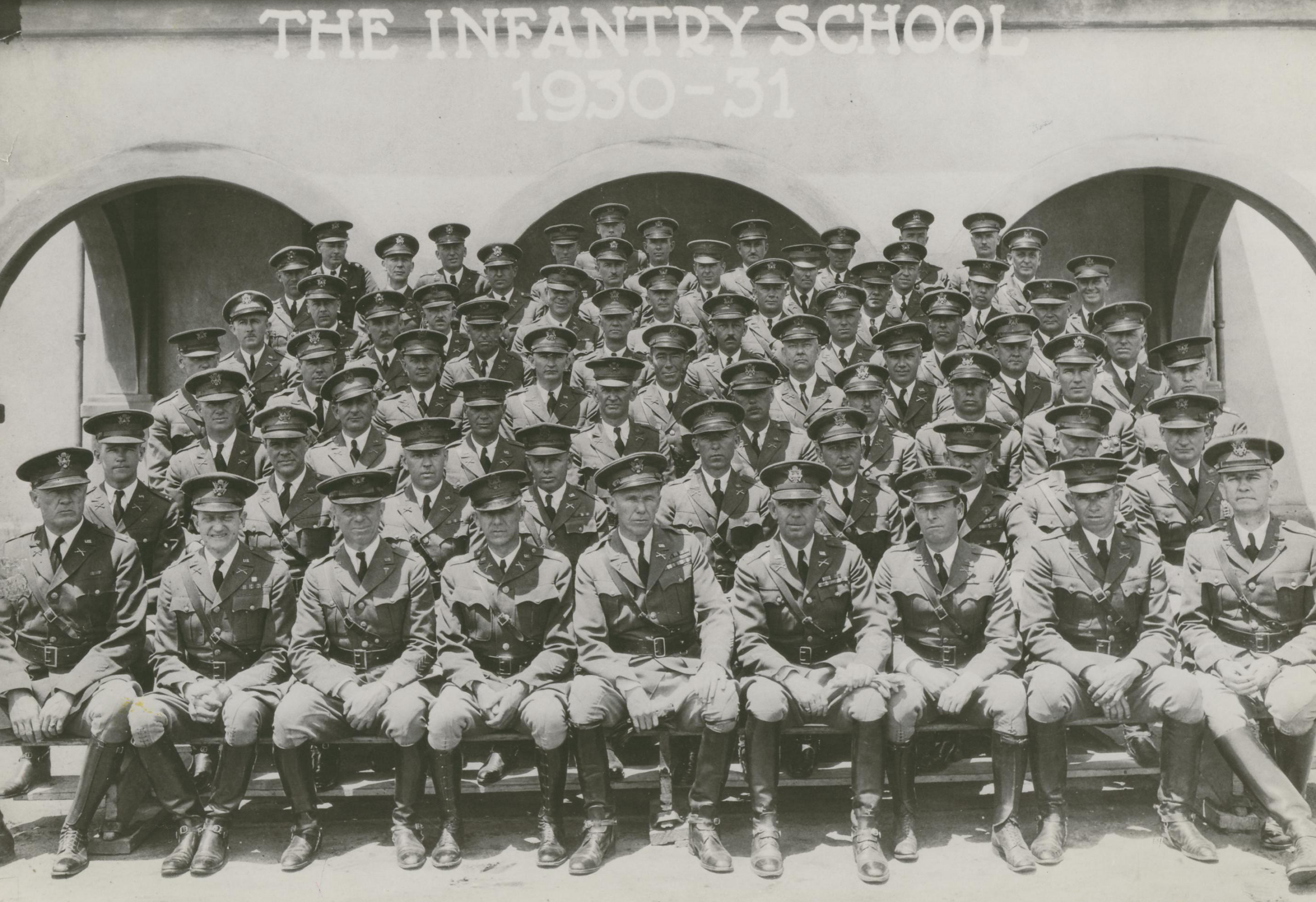
General Marshall (center front) with faculty of the Infantry School at Fort Benning, 1932.
“American servicemen were not simply soldiers; they were American soldiers.”
Both Washington and Marshall were attuned to the relationship between subject matter and pupil at all levels of instruction. American servicemen were not simply soldiers; they were American soldiers, products of a free and open society, where restraints upon individual action and expression were minimal compared to many other parts of the world. That fact could be frustrating, but it could also offer dividends. Speaking of militia during the French and Indian War, Washington complained that “every mean individual has his own crude notion of things, and must undertake to direct. If his advice is neglected, he thinks himself slighted, abased, and injured and, to redress his wrongs, will depart for his home.”
With all this Marshall could surely have agreed, convinced as he was that Americans possessed the substance to be first-rate fighting men. That meant, however, they must know the issues involved, and they must recognize that their officers were sensitive to their well-being. “Soldiers will tolerate almost anything in an officer except unfairness and ignorance,” stated Marshall, in words strikingly similar to a previously quoted admonition from Washington. “They are quick to detect either.” Marshall scholars have put such emphasis on this aspect of the General’s military thought that it hardly requires further elaboration.
War, Praise and Dissent
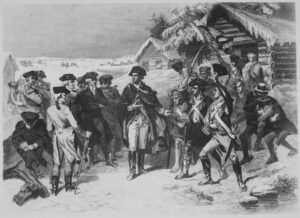
William H. Powell’s 1866 engraving “General George Washington and a Committee of Congress at Valley Forge.”
Neither Washington nor Marshall was enamored of war. If conflict had possessed a glamorous appeal in previous ages, asserted Marshall, it was no longer so in the twentieth century. Washington as president was accused of cowardly behavior in his determination to avoid hostilities in the face of British aggressions on the high seas and in the Northwest. Marshall, speaking before the American Historical Association, charged his scholarly audience with the task of investigating seriously the “deadly disease” of war, of which “a complete knowledge” was “essential before we can hope to find a cure.”
Washington and Marshall not only adjusted to the realities of war in a free society, but they were praised for doing so. Both were extolled to a degree that seems almost unhealthy in a nation that has always been somewhat uncertain in its thinking about soldiers and military institutions. It troubled John Adams and his cousin Samuel that Washington was deified by his admirers. It did not disturb Presidents Roosevelt and Truman to speak of Marshall as the indispensable man Yet our two army commanders never succumbed to a Narcissus complex, nor were they hesitant to speak out against actions and policies they considered ill-advised; and Marshall went so far as to warn Roosevelt that he would do so on his assuming the top army post in 1939.
“To be loyal is not always to be a yes man.”
Here in the nature of their occasional dissent from governmental decisions was a part of the American military tradition that is worth preserving. To be loyal is not always to be a yes man. It should be permissible, even desirable, for the military man to speak up if he feels that policies are absolutely wrong or in need of revision, provided he does so without endeavoring to create executive-legislative friction or without undermining the political and constitutional system. One wonders to what extent the the Truman-MacArthur controversy subsequently inhibited military men from speaking their minds—not only at times in favor of greater military expenditures and involvements around the world but also in terms of doing less. Historically, military men in America have been quite sensitive to criticism, and Washington and Marshall were not exceptions; but at least they understood it as the inevitable result of our personal freedoms, and they were even somewhat philosophical about it.
Civilian Experience and the Citizen Army
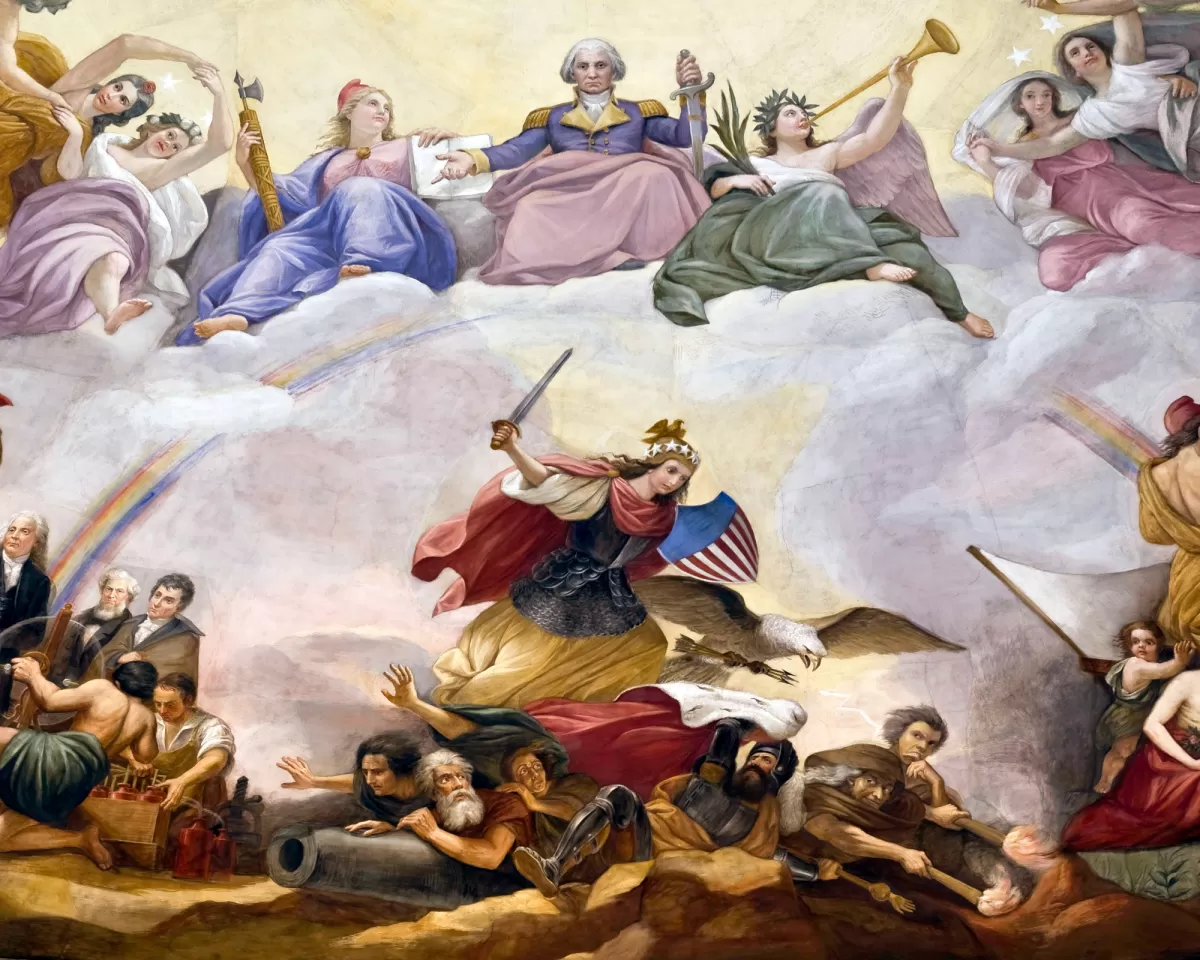
Detail of “The Apotheosis of George Washington,” in the dome of the U. S. Capitol, depicting Washington as a classical deity. Constantino Brumidi, 1865.
Whatever ills the American military feel are inflicted upon them from time to time, these can be better understood and countered if officers have had a healthy diversity of experiences with the civilian sector of American life. Washington as a young officer on the frontier had to deal with townspeople and farmers, with militiamen and volunteers, and with Virginia’s executive and legislative leaders. Subsequently he himself sat for over a decade and a half in the House of Burgesses, and in 1774–1775 he represented his province in the Continental Congress at Philadelphia. He learned how political bodies behaved, how the legislative mind perceived things. He became more appreciative of the nature and complexities of the English heritage of civil control of the military, a heritage which Britain herself seemed to threaten after 1763 when a numerous peacetime military force for the first time was stationed permanently in North America. He did so in the context of outpourings of sentiment on such subjects as the evils of maintaining standing armies, the virtues of militias composed of upstanding citizens, and specific instances of civil-military friction.
As for Marshall, his remarkable insights into civilian attitudes and values owed much to his frequent teaching assignments with the National Guard over a period of thirty years. From an early stage in his career, he was acknowledged by professionals and amateurs alike as singularly proficient in dealing with guardsmen, whom he said (as Washington had written of militia earlier) must be accorded more than customary courtesy. When in 1908 the War Department established a Division of Militia Affairs to provide greater control over the National Guard, Gen. Franklin Bell tried and failed to get Marshall appointed assistant to the division head, a compliment nonetheless to the then twenty-eight-year-old lieutenant.
“We must be prepared the next time we are involved in war, to fight immediately.”
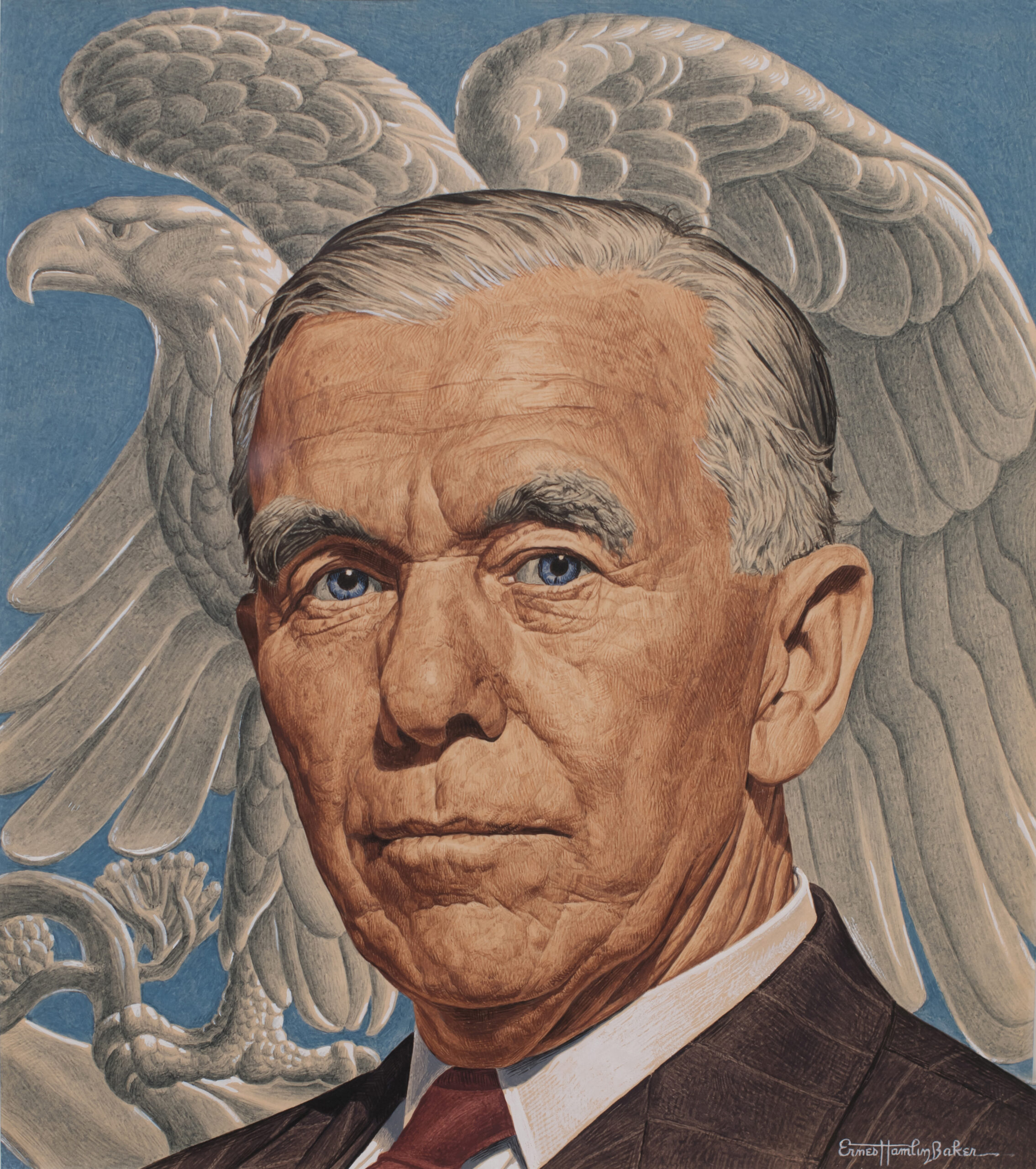
Watercolor portrait by Ernest Hamlin Baker for January 5, 1948, “Man of the Year” cover of Time. It was Marshall’s sixth appearance on the cover and his second as “Man of the Year.”
From his years with the National Guard and the CCC Marshall gained know-how in the mobilization, organization, and administration of large bodies of civilians. It proved to be crucial training for the man who as chief of staff would have the responsibility of preparing millions of draftees for duty in World War II. And for the time being, until they were ready for action, the military force that would separate America from disaster would be the National Guard. Unlike World War I, Marshall believed that subsequently America would not have the luxury of waiting months before making a heavy human commitment. “We must be prepared the next time we are involved in war, to fight immediately, that is within a few weeks, somewhere and somehow,” he advised in March 1939. “Now that means we will have to employ the National Guard for that purpose, because it will constitute the large majority of the war army of the first six months.” Yet, complained Marshall, too much of current American military training implied that the nation would begin to fight with combat-ready professionals—at Fort Leavenworth, for instance, he stated that the faculty could not see the forest for the trees.
Consequently, Marshall believed it vital to upgrade the guard. Its training would afford the miniscule peacetime army practical awareness of the art they must have when conflict erupted, to say nothing of bolstering America’s defenses and providing the nucleus of the citizen army that would ultimately fight a future war (which Marshall foresaw as coming), just as citizen forces had been the military backbone of the country in all its previous armed struggles.
The Civilian Substance of a Democratic Society
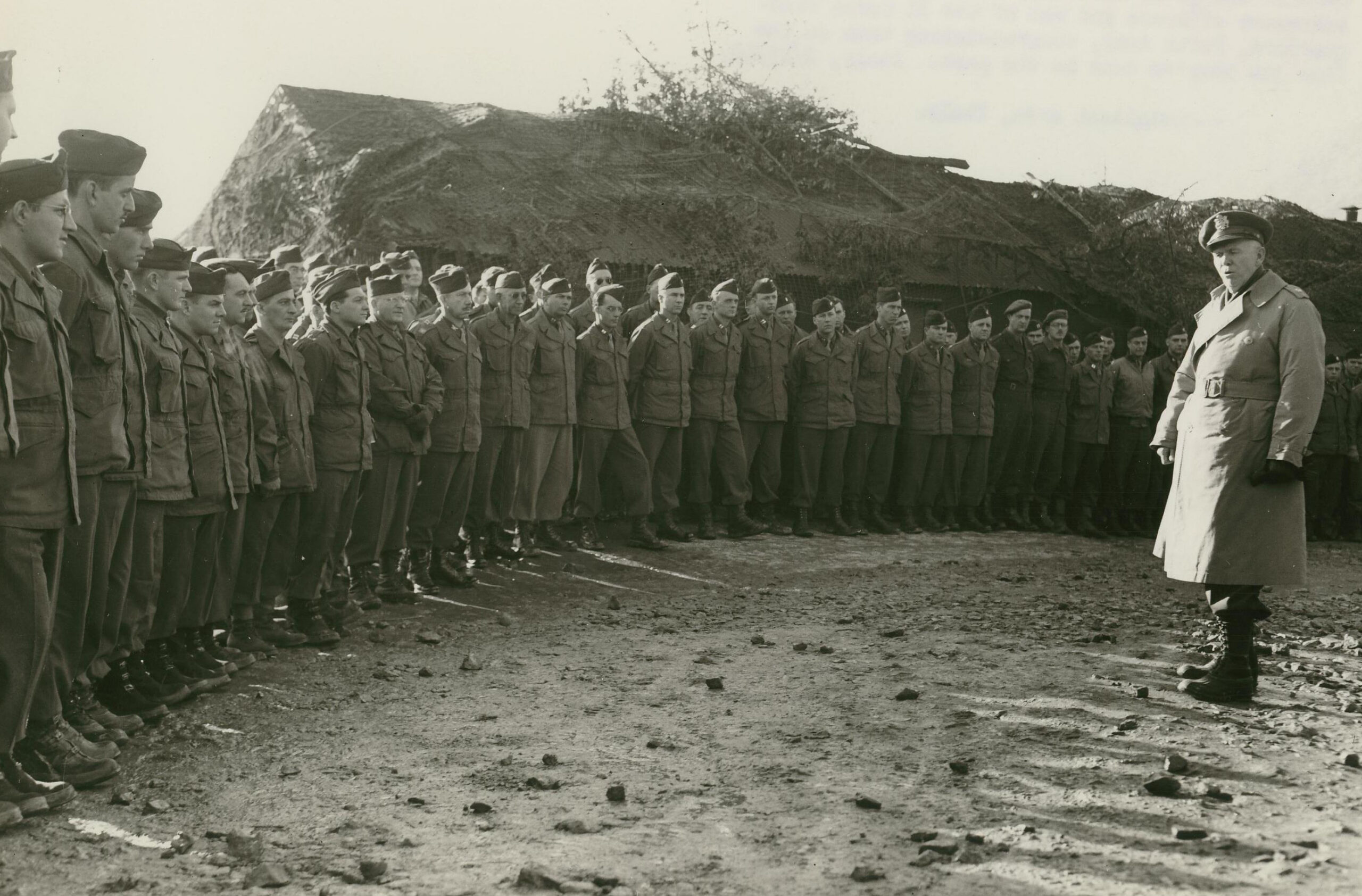
Marshall addresses officers and men of II Corps headquarters, Fifth Army, in Italy in February, 1944.
No officers have ever equaled Washington and Marshall in effectively bridging the gap between the civilian and the military. Time magazine said of Marshall: “In a general’s uniform, he stood for the civilian substance of this democratic society.” Pogue tells us that Marshall “became familiar with the civilian point of view in a way rare among professional military men.” A staff member stated the matter thusly: “Marshall had a feeling for civilians that few Army officers…have had…. He didn’t have to adjust to civilians-they were a natural part of his environment…. I think he regarded civilians and military as part of a whole.” Washington said it even better: “We should all be considered, Congress, Army, &c. as one people, embarked in one Cause, in one interest; acting in one interest: acting on the same principle and to the same End.”
Explore More from the Marshall Foundation
Read more:
Marshall at VMI
The Home of George and Katherine Marshall
Sowing Joy: Marshall’s Love of Gardening
George C. Marshall and the Virtue of Duty
Marshall and the Benning Revolution
George Marshall as Student and Teacher
Morale: Marshall’s Secret Weapon
Marshall and the Civilian Conservation Corps
George C. Marshall Papers Online
Watch:
George C. Marshall: Soldier and Statesman
George Marshall, Defender of the Republic: Character Matters
The Strained Relationship of MacArthur and Marshall
The Obligation to Serve: George Marshall and Universal Military Training